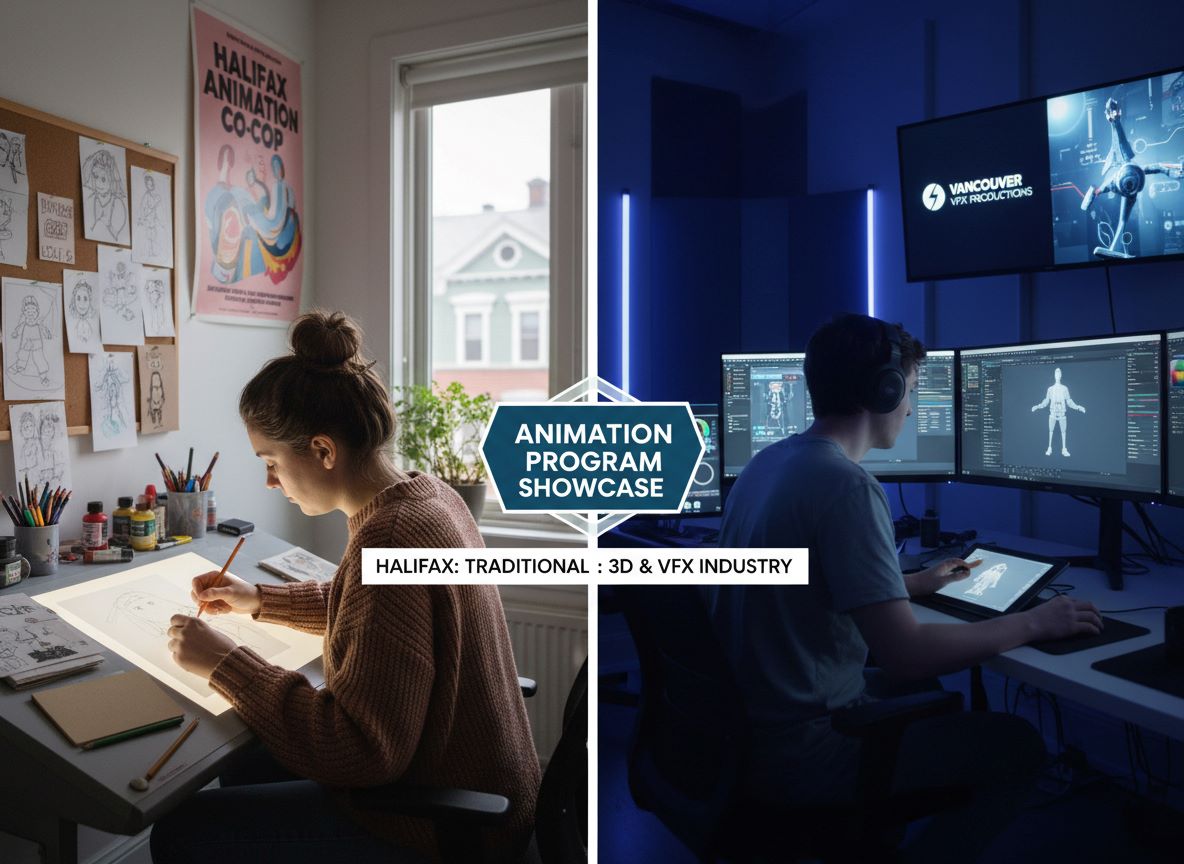
Canada’s animation industry presents two distinct educational pathways: Vancouver’s industry-focused diploma programs versus Halifax’s emerging fine arts approach. Vancouver dominates with institutions like VFS and VanArts offering job-ready diplomas, while Halifax centers around NSCAD University’s comprehensive BFA program.
The fundamental difference lies in duration and philosophy—Vancouver’s intensive 12-month programs prioritize immediate employment in major film hubs, while Halifax’s 4-year degree emphasizes artistic foundation and creative exploration. Vancouver graduates often secure positions at major studios like Industrial Light & Magic and Sony Pictures Imageworks, benefiting from the city’s status as North America’s third-largest film production center.
Overview of Animation Education in Both Cities
Vancouver’s animation education landscape revolves around studio-heavy diploma programs designed for rapid industry entry. The city’s proximity to major entertainment companies creates a direct pipeline from classroom to professional studios, with curriculum often developed in partnership with industry leaders.
Halifax presents a markedly different approach, with NSCAD University serving as the primary institution offering animation education through its Expanded Media program. This university-based model emphasizes broader artistic development over specialized technical training, preparing students for diverse creative careers rather than specific industry roles.
The data reveals Vancouver’s clear dominance in animation education, with multiple specialized institutions competing for students. Halifax’s more limited options reflect the city’s developing animation scene, though this creates opportunities for personalized attention and unique artistic perspectives often absent from larger programs.
Vancouver’s Industry Hub Status
- Home to VFS, ranked #1 animation school globally by multiple industry publications
- Direct access to over 60 major film and animation studios within the metropolitan area
- High demand for VFX professionals drives consistent job placement rates above 85%
- Industry partnerships provide real-world project experience during studies
- Proximity to Hollywood North productions creates networking opportunities
- Government tax incentives attract international productions, increasing employment opportunities
Halifax’s Creative Foundations
NSCAD University approaches animation as part of a broader media arts education, integrating traditional fine arts principles with digital storytelling techniques. This methodology produces graduates with strong conceptual thinking and artistic versatility, though with less specialized technical training than their Vancouver counterparts.
The program’s emphasis on experimental media and interdisciplinary collaboration creates unique opportunities for students to explore animation’s artistic potential beyond commercial applications. While this approach may extend time to employment, it develops well-rounded creative professionals capable of adapting to evolving industry demands.
Key Animation Programs in Vancouver
| School | Program | Duration | Credential | Specializations |
|---|---|---|---|---|
| Vancouver Film School | 3D Animation & VFX | 12 months | Diploma | Character Animation, VFX, Motion Capture |
| VanArts | 2D/3D Character Animation | 12 months | Diploma | Classical Animation, Digital Character |
| Think Tank Training | VFX for Film & TV | 21 months | Diploma | Compositing, FX, Lighting |
| LaSalle College | 3D Modeling & Animation | 16 months | Diploma | Game Design, Architectural Viz |
| VANAS | Animation & Illustration | 8 weeks | Certificate | Digital Art, Concept Design |
| Centre for Arts & Technology | 3D Animation & Visual Effects | 18 months | Diploma | Game Animation, Film VFX |
Vancouver’s animation education ecosystem offers remarkable diversity in program length and specialization, accommodating different career goals and time constraints. The concentration of multiple specialized institutions creates healthy competition and continuous curriculum innovation.
VFS Programs Deep Dive
Vancouver Film School offers three distinct animation pathways designed for different career trajectories. The 3D Animation & VFX program focuses on industry-standard software mastery and portfolio development, with students completing professional-quality projects suitable for demo reels.
The Classical Animation program preserves traditional hand-drawn techniques while incorporating digital tools, appealing to students interested in feature animation and artistic storytelling. The Concept Art program bridges animation and game design, developing visual development skills crucial for pre-production work.
All VFS programs emphasize practical learning through real-world projects, with industry professionals serving as instructors and mentors. This approach ensures graduates possess immediately applicable skills and professional networks essential for career launch.
Alternative Vancouver Options
- VanArts – Highest graduate satisfaction rates with personalized instruction and strong industry connections in both film and game industries
- Think Tank Training – Specialized VFX focus with direct studio partnerships and proven placement records at major facilities
- LaSalle College – Comprehensive program combining animation with business skills and entrepreneurship training
- Centre for Arts & Technology – Strong technical foundation with emphasis on emerging technologies and virtual production
- VANAS – Flexible scheduling and online options ideal for working professionals and career changers
Animation Programs in Halifax
Halifax’s animation education centers primarily around NSCAD University’s BFA in Expanded Media, which approaches animation as one component of a broader interdisciplinary arts education. This four-year program integrates traditional fine arts training with digital media exploration, producing graduates with strong conceptual foundations.
The program’s fine arts approach distinguishes it from Vancouver’s technical focus, emphasizing artistic vision, critical thinking, and experimental approaches to moving image creation. Students explore various media forms including video art, interactive installations, and narrative animation.
While Halifax lacks the specialized animation schools found in Vancouver, this limitation creates opportunities for individualized attention and unique artistic development. Faculty mentorship and small class sizes enable deep exploration of personal artistic voice, often resulting in distinctive and innovative work.
NSCAD University Details
| Aspect | Details | Outcomes |
|---|---|---|
| Program Structure | 4-year BFA with foundation year, major specialization, thesis project | Well-rounded artists with strong conceptual thinking |
| Class Sizes | Small cohorts of 15-20 students per year | Personalized faculty mentorship and peer collaboration |
| Technical Training | Balanced approach combining traditional and digital media | Versatile skill set adaptable to various creative industries |
| Career Preparation | Focus on artistic development over immediate employability | Graduates often pursue further education or independent practice |
NSCAD’s extended timeline contrasts sharply with Vancouver’s job-ready approach, reflecting different educational philosophies and career objectives. The longer duration allows for artistic maturation and exploration of various creative directions, though it delays entry into the professional workforce.
This comprehensive approach produces graduates with broader creative capabilities but requires greater time and financial investment. The university environment also provides access to diverse artistic communities and interdisciplinary collaboration opportunities unavailable in specialized trade schools.
Program Duration Comparison
| City | Shortest Program | Typical Duration | Longest Program |
|---|---|---|---|
| Vancouver | 8 weeks (VANAS Certificate) | 12-16 months | 21 months (Think Tank) |
| Halifax | 4 years (NSCAD BFA) | 4 years | 4 years |
| Time to Employment | 3-6 months post-graduation | 6-12 months post-graduation | Varies widely |
| Industry Readiness | Immediate technical skills | Comprehensive artistic foundation | Advanced specialization |
The duration disparity reflects fundamentally different educational approaches and career objectives. Vancouver’s compressed timeframes prioritize rapid skill acquisition and industry entry, while Halifax’s extended program develops broader artistic capabilities and critical thinking skills.
Diploma vs Degree Timelines
Vancouver’s diploma programs offer compelling advantages for students seeking immediate career change or rapid industry entry. The intensive, focused curriculum eliminates general education requirements, concentrating exclusively on practical skills and portfolio development.
This streamlined approach reduces both time investment and educational costs while providing faster return on investment through quicker employment. Students can begin earning industry salaries within 18 months of starting their education, compared to Halifax’s four-year commitment.
Time to Employment Impact
- Vancouver graduates typically secure entry-level positions within 6 months of graduation due to local industry demand
- Shorter programs reduce total educational costs and minimize student debt burdens
- Industry-focused curriculum ensures skills directly align with current employer needs and technology standards
- Halifax graduates often require additional technical training or portfolio development before securing animation positions
- Extended study period allows for deeper artistic development and stronger conceptual foundations
- University credentials provide flexibility for career transitions or advanced education opportunities
Career Outcomes and Employability
| Metric | Vancouver | Halifax |
|---|---|---|
| Job Placement Rate | 85-95% within 6 months | Limited specific data available |
| Starting Salary Range | $45,000-$65,000 CAD | $35,000-$50,000 CAD |
| Industry Connections | Direct studio partnerships | Academic and arts networks |
| Career Flexibility | Animation-specific roles | Diverse creative industries |
| Geographic Mobility | Global animation hubs | Regional arts communities |
Vancouver’s superior career outcomes reflect the city’s established animation industry and direct connections between educational institutions and major studios. VFS’s claiming “trained and hired in 12 months” demonstrates the efficiency of industry-aligned education. However, Halifax graduates often enjoy greater career flexibility, with their fine arts foundation enabling success in various creative fields beyond animation.
The salary differential reflects both regional economic differences and industry concentration. Vancouver’s competitive animation market drives higher wages, while Halifax’s smaller market offers fewer specialized positions but potentially greater creative autonomy and lower living costs.
Employment patterns also differ significantly—Vancouver graduates typically enter large studio environments with structured career progression, while Halifax alumni often pursue independent practice, freelance work, or positions in related creative industries requiring broader skill sets.
Job Placement Stats
Vancouver institutions consistently report placement rates above 85%, with VFS and Think Tank achieving rates near 95% for graduates willing to relocate within North America. The “trained and hired in 12 months” promise reflects strong industry partnerships and curriculum alignment with current production needs.
Halifax placement data proves more challenging to quantify due to NSCAD’s broader program focus and graduates’ diverse career paths. Many alumni pursue further education, independent artistic practice, or positions in related creative fields, making traditional placement metrics less applicable to their educational model.
Cost and Accessibility Factors
- Vancouver program tuition ranges from $20,000-$45,000 CAD for full diploma programs
- Halifax university tuition averages $12,000-$15,000 CAD annually for domestic students
- Living costs in Vancouver significantly exceed Halifax expenses, particularly housing
- Vancouver programs offer intensive scheduling allowing faster employment and income generation
- Halifax provides traditional student lifestyle with campus amenities and broader social experiences
- Financial aid and scholarship opportunities differ between private institutions and public universities
Tuition Breakdown
| Program | 1st Year Cost | Total Est. |
|---|---|---|
| VFS Animation | $42,500 CAD | $42,500 CAD |
| VanArts Animation | $24,900 CAD | $24,900 CAD |
| Think Tank VFX | $28,000 CAD | $49,000 CAD |
| NSCAD Expanded Media | $14,500 CAD | $58,000 CAD |
The cost comparison reveals complex trade-offs between upfront investment and long-term financial impact. Vancouver’s higher tuition costs are offset by shorter program duration and higher starting salaries, while Halifax’s lower annual costs extend over four years.
Online vs In-Person Options
VanArts and several Vancouver institutions offer robust online programs maintaining the same curriculum quality and industry connections as their on-campus counterparts. These digital options increase accessibility for students unable to relocate while preserving direct industry mentorship and networking opportunities.
NSCAD maintains a traditional on-campus model emphasizing hands-on studio work and face-to-face collaboration. This approach reflects the program’s fine arts foundation and belief that artistic development requires physical creative spaces and direct peer interaction.
Industry Connections and Rankings
Vancouver’s animation schools dominate national and international rankings, with VFS consistently rated as the #1 animation school globally by industry publications and employer surveys. These rankings reflect both program quality and graduate success in securing positions at prestigious studios worldwide.
Halifax institutions rarely appear on specialized animation school rankings, primarily due to their broader academic focus and smaller program size. However, NSCAD maintains strong recognition in fine arts education and regional creative industries, providing different but valuable networking opportunities.
Global and National Rankings
| Rank | School | City | Program Focus |
|---|---|---|---|
| 1 | Vancouver Film School | Vancouver | 3D Animation & VFX |
| 3 | VanArts | Vancouver | Character Animation |
| 7 | Think Tank Training | Vancouver | VFX Specialization |
| 15 | LaSalle College | Vancouver | 3D Modeling |
| Unranked | NSCAD University | Halifax | Expanded Media |
Pros and Cons: Halifax vs Vancouver
| Factor | Vancouver Pros | Vancouver Cons | Halifax Pros | Halifax Cons |
|---|---|---|---|---|
| Speed to Career | 12-month job readiness | Limited artistic depth | Comprehensive foundation | 4-year commitment |
| Industry Access | Direct studio connections | High competition | Personalized attention | Limited local opportunities |
| Educational Cost | Faster ROI | Higher upfront costs | Lower annual tuition | Extended financial commitment |
| Skill Development | Industry-current technical skills | Narrow specialization | Broad creative capabilities | Less technical specialization |
| Living Situation | Major metropolitan amenities | High cost of living | Affordable lifestyle | Limited entertainment options |
| Career Flexibility | Global animation industry access | Animation-specific training | Multiple creative career paths | May require additional training |
The comparison reveals fundamentally different educational philosophies serving distinct student populations and career objectives. Vancouver’s model prioritizes rapid industry integration and technical proficiency, while Halifax emphasizes artistic development and creative exploration.
For Career Changers
- Assess current financial situation and ability to sustain extended education without income
- Evaluate existing skills and determine whether technical training or artistic development better serves career goals
- Research target employment markets and determine geographic flexibility for job opportunities
- Consider personal learning preferences between intensive focused study and comprehensive academic exploration
- Connect with alumni from both programs to understand real-world career trajectories and satisfaction levels
For Traditional Artists
Students with existing fine arts backgrounds may find Halifax’s approach more compatible with their artistic development goals and creative values. NSCAD’s integration of traditional and digital media allows for experimental approaches and personal artistic voice development often constrained in industry-focused programs.
However, traditional artists seeking immediate career change should seriously consider Vancouver’s technical training advantages. The concentrated skill acquisition and industry connections can provide faster transition from artistic practice to professional animation employment, though potentially at the cost of creative exploration.
Which City Wins for Animation?
- Vancouver dominates for students seeking immediate industry entry and technical specialization in major studio environments
- Halifax excels for learners prioritizing artistic development, creative exploration, and flexible career opportunities
- Career changers benefit from Vancouver’s efficiency and direct path to employment in established animation hubs
- Fine arts students may prefer Halifax’s comprehensive approach and integration with broader creative communities
- Budget-conscious students should consider total program costs including living expenses and time to employment
- Geographic preferences matter significantly due to different industry concentrations and lifestyle costs
- Long-term career goals should drive the decision between technical specialization and artistic versatility
Final Decision Framework
| Goal | Recommended City | Top Program |
|---|---|---|
| Fast Industry Entry | Vancouver | VFS 3D Animation & VFX |
| Artistic Development | Halifax | NSCAD Expanded Media |
| Career Change | Vancouver | VanArts Character Animation |
| Creative Flexibility | Halifax | NSCAD Expanded Media |
The choice between Halifax and Vancouver animation education ultimately depends on individual career objectives, learning preferences, and life circumstances. Vancouver offers unmatched industry access and rapid career launch, while Halifax provides comprehensive artistic development and creative flexibility. Both paths can lead to successful animation careers, but through markedly different educational experiences and timeline commitments.